Employment Rights Act 2025
Published
·
10 minute read
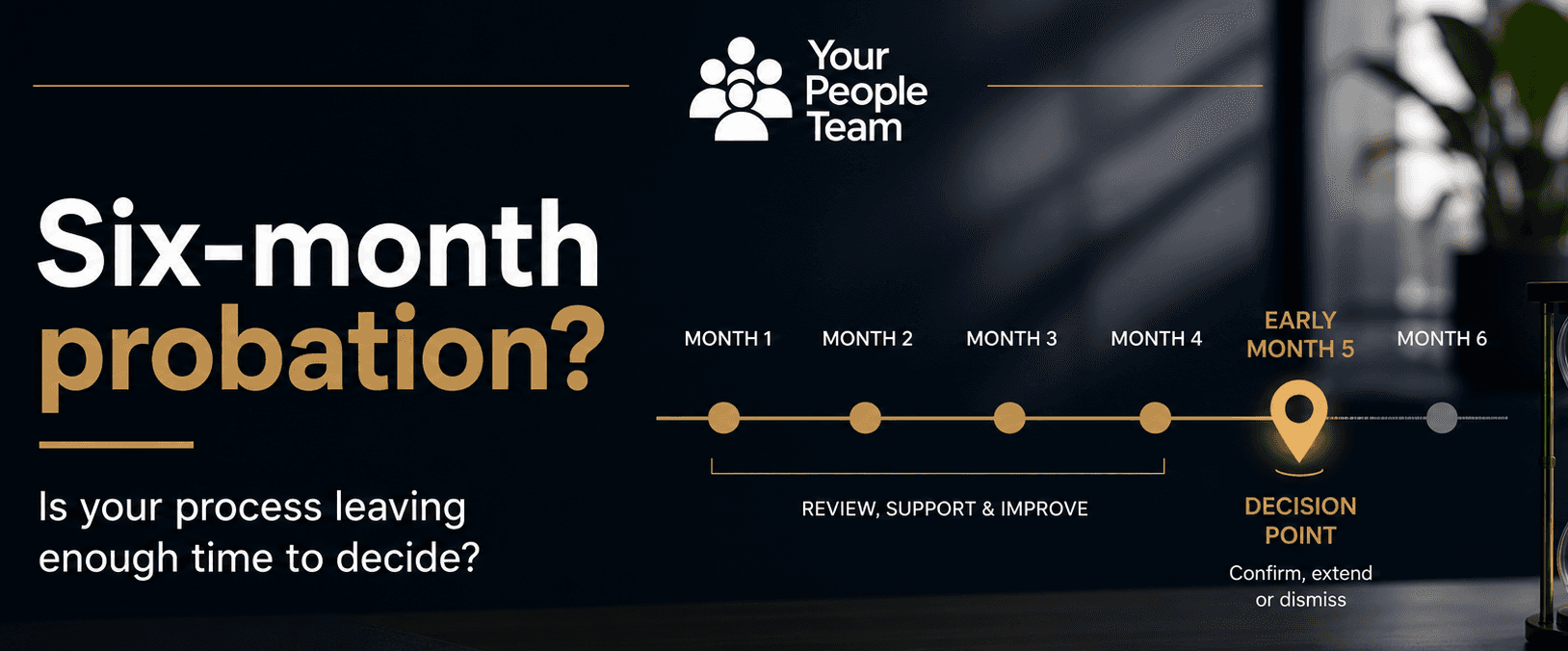
The Employment Rights Act 2025 shortens the qualifying period for ordinary unfair dismissal. Employers should respond by creating earlier decision points, clearer expectations and enough time to deal properly with problems when they arise.
From 1 January 2027, employees will ordinarily qualify for protection against unfair dismissal after six months’ service rather than two years. The cap on compensatory awards will also be removed. Existing protections against discrimination and automatically unfair dismissal remain, but for the routine question of whether a new appointment is working, employers will have far less time before a fair reason and fair process become essential.
There has been no shortage of commentary about the increased risk this creates. Much of it stops at telling employers that dismissal will become more difficult and potentially more expensive. That is true, but it is not especially useful. Employers need a workable response, and in my view that means reconsidering the standard six month probation period rather than simply leaving it in place and hoping managers become more organised.
A contractual probation period does not postpone the point at which statutory protection arises. There is no legal requirement for probation to last six months, or even to have one at all, and Acas now specifically advises employers to tailor probation to the role and consider whether it should end before ordinary unfair dismissal protection is acquired.
There is also an immediate timing issue. The government intends the new protection to apply from 1 January 2027 to employees who already have six months’ service, not only to people recruited after that date. Employees who started work on or around 1 July 2026 will therefore be among the first affected. The relevant probation periods are already under way.
Why the decision window is shorter than six months
A six month probation period looks generous on paper. In practice, much of it can pass before the employer has enough evidence to reach a sound decision.
The opening weeks are usually spent on induction, training and learning internal systems. Some concerns do not become apparent until the employee begins working independently. Managers are also understandably reluctant to draw conclusions too soon, particularly where someone is adjusting to a new organisation or taking on unfamiliar responsibilities.
The problem begins when a reasonable desire to give someone time becomes prolonged avoidance of a necessary conversation. A manager notices missed details or slow turnaround in month two but assumes the employee will improve. The concern is mentioned informally but not recorded. The formal review is then postponed because of annual leave, sickness absence or an operational deadline. By month four, the issue is serious enough to require clear targets, additional support and a reasonable period in which to demonstrate improvement.
None of those decisions is necessarily wrong. Together, however, they can leave the organisation trying to make an important employment decision at the very end of the probation period.
Statutory notice makes the window tighter still. An employee with at least one month’s service is normally entitled to at least one week’s statutory notice. Where the employer terminates employment without giving that notice, the statutory notice period can, in certain circumstances, be added when calculating qualifying service for unfair dismissal purposes.
The Employment Appeal Tribunal considered this issue in Lancaster and Duke Ltd v Wileman. The case confirms that the statutory extension does not apply where the employer was genuinely entitled to dismiss summarily for gross misconduct. Crucially, however, the issue depends on whether the employee’s conduct legally justified dismissal without notice. It is not resolved simply by describing the dismissal as summary or labelling the conduct gross misconduct in the outcome letter.
The employer’s motive for trying to conclude matters before the qualifying threshold is not, by itself, the legal test. The more immediate risk is that the statutory calculation may not produce the termination date the employer intended. A tribunal will examine the actual chronology, the notice entitlement and, where summary dismissal is relied upon, whether the conduct genuinely removed the right to notice.
For many employees, five months and three weeks may appear to be the last possible point at which an immediate termination could remain below the six month threshold. It would be a mistake to turn that calculation into a management deadline. It leaves no useful room for a postponed meeting, further evidence, HR or legal advice, a contractual notice period longer than one week, or a proper opportunity for the employee to respond.
For most roles, the final decision to confirm the appointment or terminate employment should be reached by early month five at the latest. Where the contract provides for longer notice, the decision point will need to be earlier. Early month five is not a statutory safe harbour; it is a sensible internal risk control designed to stop the organisation managing against the legal boundary.
A probation model that leaves room to manage
For most SMEs, I do not think the best response is to retain six month probation periods for every role and rely on managers to use the time more efficiently. A shorter initial period creates an earlier decision point and more flexibility when something unexpected happens.
For many operational, administrative and supervisory roles, a three month probation period should normally provide enough time to assess performance, conduct, attendance and suitability. For senior, specialist or technically complex appointments, four months may be more appropriate because the induction is longer or the employee needs time to complete a meaningful cycle of work.
A shorter initial period does not mean rushing decisions or giving employees less support. It means that the employer must assess progress earlier. If the employee is meeting the required standard, they can be confirmed in post. If there are identifiable concerns but a realistic prospect of improvement, probation can be extended once with clear objectives and a defined end date. If the appointment is plainly not working, the organisation has time to deal with that without counting individual days before the statutory threshold.
A practical structure could look like this:
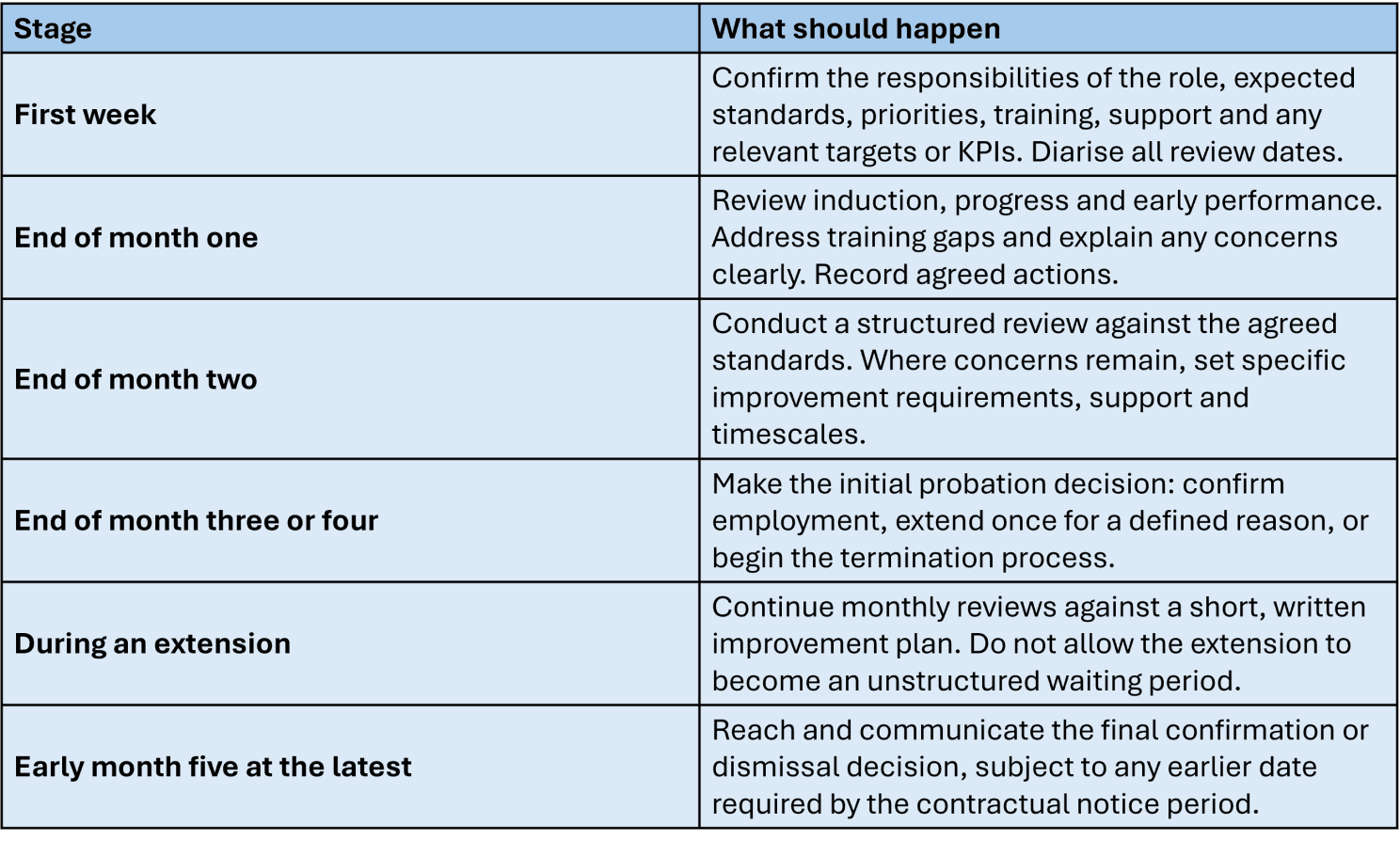
A three month initial period leaves room for a meaningful extension where the employee has shown potential but needs more time. A four month period provides a similar structure for more complex roles, although any extension will necessarily be shorter. If a role genuinely requires a substantially longer assessment period, that should be recognised when the initial timetable is designed rather than addressed through repeated extensions.
Extensions should not become the default response whenever a manager is uncertain. The employee should be told why confirmation is not yet possible, what remains below standard, what improvement is required, what support will be provided, how progress will be assessed and when the final decision will be made. One properly managed extension should normally be enough.
Sickness absence may justify adjusting the assessment timetable, particularly where the employee has not had a reasonable opportunity to demonstrate their capability. It may also raise disability and reasonable adjustment issues that require separate consideration. The answer is not to extend automatically or treat the absence itself as evidence that the appointment has failed. It is to identify what can fairly be assessed, what support may be required and whether specialist advice is needed.
What monthly reviews need to achieve
Changing the length of probation will achieve very little unless the management process changes with it. A probation period should be an active programme of assessment and support, not a final meeting held shortly before the contractual end date.
At the outset, the employee should understand what successful probation will look like. Depending on the role, this may involve performance targets, service standards, learning objectives, behavioural expectations or measurable KPIs. Not every job lends itself to numerical targets, but every role should have standards that can be explained and assessed with reasonable clarity.
Vague expectations are rarely helpful. Telling an employee to “show more initiative” does not explain what they need to do differently. A better objective might require them to identify emerging problems, propose solutions before escalating them, take ownership of agreed work and alert the manager before a deadline is at risk. Similarly, “improve communication” should be translated into observable requirements such as providing accurate progress updates, responding within agreed timescales and raising delays promptly.
Monthly reviews should be the minimum for most roles. They do not need to be lengthy or adversarial. Where the employee is progressing well, the meeting may be relatively brief. Its value lies in creating a regular opportunity to confirm what is working, address concerns, identify support and ensure that the eventual outcome does not come as a surprise. Acas recommends regular formal reviews, honest feedback and written records shared with the employee.
Where performance falls below the required standard, the manager should explain the concern, provide examples and describe what improvement would look like. The employee must have an opportunity to respond. The apparent performance issue may reflect inadequate induction, unclear instructions, an unreasonable workload, missing equipment or a health condition requiring support.
The written record does not need to become an essay. It should show what was expected, what was discussed, what evidence was considered, what the employee said, what support was agreed and what needs to happen next. A concise record written at the time is usually far more useful than a detailed account reconstructed when dismissal is already being considered.
The process also needs clear ownership. Review dates should be monitored through the HR system, a central tracker or reliable calendar prompts. Depending entirely on individual managers remembering a date several months into the future will produce inconsistent results. There should also be an escalation point so that HR or a senior manager is alerted when a review is missed or significant concerns are recorded.
Recruitment and manager capability are part of the solution
The shorter qualifying period also makes sound recruitment more important. A well designed probation process cannot consistently compensate for poor appointment decisions.
Interview questions should test the actual requirements of the role rather than simply produce a comfortable conversation. Candidates should receive a realistic account of the work, including the difficult or less attractive parts. Qualifications, professional registrations and references should be checked where relevant, and the reasons for selecting the successful candidate should be recorded against clear criteria.
Recruitment, induction and probation should then operate as one continuous process. The capabilities assessed during recruitment should inform the objectives set after appointment. If a candidate was selected partly because of their experience managing projects, dealing with customers or supervising a team, those capabilities should feature in the probation reviews. If the interview identified an area requiring development, it should be addressed through the induction plan rather than rediscovered months later as an unexpected weakness.
Managers also need more than a template form. Many delay feedback because they want to be fair, do not want to damage the employee’s confidence or hope that matters will improve without intervention. Those instincts are understandable, but delayed feedback is rarely kind.
An employee told in month two that deadlines are being missed has a genuine opportunity to improve. An employee given reassuring messages for four or five months and then told unexpectedly that they have failed probation is likely to feel blindsided, even where the underlying concern is legitimate.
Practical manager guidance should therefore cover how to set useful objectives, give evidence based feedback, distinguish an isolated mistake from a pattern, explore the employee’s explanation and recognise when HR advice is needed. It should also make clear that probation is not a disciplinary shortcut. Employees continue to have protection against discrimination, whistleblowing and automatically unfair dismissal from the outset, and any issue potentially connected to health, pregnancy, family leave, trade union activity or the exercise of a statutory right must be handled with particular care.
What employers should do now
Employers should begin by identifying anyone who will have six months’ service on or shortly after 1 January 2027. Managers should check whether objectives have been set, whether reviews have happened and whether any concerns are being addressed. Those employees should not reach the end of 2026 with an empty probation file and a manager who has privately doubted the appointment for several months.
Contracts and policies should then be reviewed together. Employers need to consider the appropriate initial probation period for different categories of role, whether the contract permits an extension, the notice period that applies during probation, who can authorise an extension or dismissal and whether the internal process allows decisions to be reached before notice becomes critical.
For many SMEs, a sensible default will be three months for most roles and four months for senior or complex appointments, supported by monthly reviews and one purposeful extension where there is a genuine prospect of improvement. The final pass or dismissal decision should be made by early month five at the latest, and sooner where the contractual notice period requires it.
That is not a statutory formula. Some organisations and roles will require a different structure. The important point is that the timetable is chosen deliberately, reflects the role and leaves enough room for the process to work when meetings are postponed, evidence is disputed or absence interrupts the assessment.
The Employment Rights Act 2025 does not make probation redundant, but it does make an unmanaged six month process a poor form of protection. Employers that create earlier decision points, give managers practical guidance and maintain straightforward records should be able to adapt without treating every new appointment as a future tribunal claim.
For organisations that would prefer not to build the process from scratch, Your People Team provides probation process reviews, manager guidance, review templates, KPI frameworks and complete probation management packs. Our next article will look at what a useful probation review record should contain, and the common wording that makes those records less helpful when a decision is challenged.